Monday, October 13, 2014

Divergent/The Time Keeper/Everything But the Brain

Hello everyone. I am really sorry this is late. Here are the three books (technically two novels and one graphic novel) I have looked at for teaching Literature in the Secondary School classroom.

EDIT: I originally had Marvel Civil War. Upon realising that Clare already included that, PLUS the fact that I had no MOE-Approved text in my 3... I have swapped it for Everything but the Brain. Sorry for the messiness.


Divergent by Veronica Roth (YA)
So... the first book is a dystopian young-adult fiction novel. I think I have heard that phrase a little too much recently. Anyhow, the book about is about a post-apocalyptic Chicago that has seen its society segmented into five different classes: Abnegation, Erudite, Dauntless, Candor and Amity.  At the age of sixteen (thankfully not 12 this time. Poor Primrose Everdeen) teeangers are made to do an aptitude test from which they can then "choose" their factions from. The term "faction over blood" suggests a sense of how each member of this society is deeply entrenched into their roles as a particular faction's member. It turns out the sciency faction Erudite have concocted a cunning plan to brainwash the dauntless (depicted in the film as crazy blood-hungry and risk-taking hooligans - actually the depiction in the book isn't THAT far off) into become a military unit which they will use to take over the world Chicago. Tris the Protagonist is special, she is "divergent" which means she can think in multiple ways (in other words, like a normal human being and not a conditioned robot) and demonstrates all the qualities of the differrent factions. She along with some allies such as her parents and her instructor, Four, thwart Erudite's plan, playing many violent laser-tag like games in the name of "initiation".
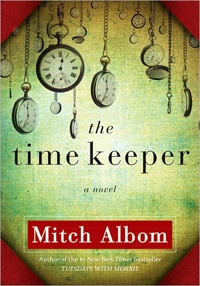


The Time Keeper by Mitch Albom (OTHER)
My second book is Mitch Albom's The Time Keeper. Mitch (I like to pretend he's my friend) has an epic ability to make really short, meaningful tear-jerking books. Some of us will remember him of The Five People You Meet in Heaven fame. I know some of us have read all his books as well. Anyway, The Time Keeper features a very cool use of split-narrative, following three protagonists in Dor, Sarah and Victor. Dor is the Father of Time, the first human to mark time with stones, sticks, etc. Sarah is a girl who slowly finds herself wishing she had no more time alive, and wants to just fade out of existence, whereas Victor is a really rich guy who attempts to become immortal. Through the three characters' stories, we discover what the true meaning of time is and why it exists. Deep meaningful stuff in very bite-sized and manageable portions.

I don't know why my review of the novel is beginning to sound more like a restaurant review.


Everything but the Brain by Jean Tay (MOE Approved)
What do Physics, three bears and a stroke have in common? Take a journey with Elaine, a middle-aged physics teacher, as she explains the theory of relativity using the metaphor of three bears and a train, an devises a plan to turn back time and save her ailing father from physical deterioration.

This play hits home in so many ways for me, and is my favourite Singaporean play. I personally think it involves a very specific brand of local in the way the characters are built and interact, but that the issues covered in the play are very, very universal. The play is fun to read, and to do role-play in class, and can offer a lot of opportunity for students to explore the possibilities of drama. More than just that, the use of the train as an extended metaphor for Elaine's inability to deal with her father's impending death is an extremely powerful one that offers a lot of depth for analysis. The three bears offer a lot of humour, and can be helpful to teach students how humour is constructed in the play and even to talk about why the humour is important (the laughter makes the sadness even more poignant, etc.) Speaking of which, time features very heavily in this play too, so I think I'm beginning to show my internal bias for time-related/based narratives.

THE DECISION
*deep breath* re-writing this after giving Marvel Civil War a resounding yes. Sadly, that is off my list at the moment.

I am inclined to go with Everything but the Brain for a variety of reasons. As an introduction to local plays and literature, I think it is a wonderful entry-point that teaches students that Drama, as well as Singaporean literature, can be both funny, humorous and tongue-in-cheek while at the same time be poignant and universal. I personally believe there is a lot of local literature centred upon the idea of a tension in the identity between the different groups of people who live in Singapore... or about issues such as censorship or surveillance. I am not discrediting these works - they are doing very very important work for the local writing scene. The issue is that I don't see secondary school students relating with issues of censorship as much as we do - and so things like Fear of Writing (Tan Tarn How) may not be as relateable.

On that note, by choosing Everything as my hypothetical text, I want students to learn that literature is about having fun while tackling the very things that make us human in whatever way best expresses ourselves... Whether it is through physics, the fairytale style of three bears, or a train metaphor. I am less inclined to Divergent because I think it's a very weak YA novel compared to Hunger Games or Harry Potter in terms of characterisation, plot structure and use of language. The Time Keeper is really short, and may lend well to smaller time-frames, or if used as a way to include a larger variety of texts in the syllabus, and I think it offers a lot to students at the Secondary school level. Perhaps Everything could be the primary text, while the bite-sized nature of Time Keeper will be useful to keep in mind for unseen exercises? :D

Sunday, October 12, 2014

Julie of the Wolves/To Kill a Mockingbird/Miss Peregrine's Home for Peculiar Children


Book Summaries (extracted from the books)

 Julie of the Wolves tells the story of a young thirteen-year-old Eskimo girl, Miyax, who runs away from an unhappy arranged marriage in the hopes of reaching San Francisco. Her pen pal, Amy, who calls her Julie, has a beautiful modern house on the hills and always ends her letters with "Julie, when are you coming to visit?" However, on her way there, Miyax gets lost on the North Slope of Alaska, where the view in every direction is exactly the same and her life hangs on the balance. Slowly, she gets accepted into a pack of Arctic wolves who save her life and she comes to love them as though they were her brothers. Forced to rethink her Eskimo past, Miyax/Julie begins to see that her future would never be easy. It is a tale of a girl's courage and the will to survive in potentially alien worlds. 
Jacob Portman, a 16-year-old boy, goes to Wales to find out the truth of his grandfather's past after he was murdered by what Jacob thought was a make-believe creature. When he arrives, he finds the home where his grandfather and the peculiar children stayed. That is where he meets Emma, a "strikingly pretty" girl who can control fire. She takes him to meet Miss Peregrine in a time loop set back in 1940. Jacob enjoys hanging out with the other peculiar children, such as Millard, who is invisible, and Bronwyn, who has incredible strength. Then Jacob is told some mysterious stories of strange killings in the pub he's staying at, and warns the peculiar children. When they tell Jacob he is the only one who can see the "hollows" or "hollowgasts", the monsters that killed Jacob's grandfather, Jacob knows he is the only hope they have for safety.
Jacob and some of the peculiar children encounter a hollow which Jacob kills. Upon return to the Miss Peregrine's home, they find that Miss Peregrine has been kidnapped. The children rescue Miss Peregrine, but she is in bird form and cannot change back to human form. At the end of the book, the peculiar children look for another time loop they can stay in because their current one has been taken over by hollows.

The story takes place during three years (1933–35) of the Great Depression in the fictional "tired old town" of Maycomb, Alabama, the seat of Maycomb County. It focuses on six-year-old Scout Finch, who lives with her older brother, Jem, and their widowed father, Atticus, a middle-aged lawyer. Jem and Scout befriend a boy named Dill, who visits Maycomb to stay with his aunt each summer. The three children are terrified of, and fascinated by, their neighbor, the reclusive "Boo" Radley. The adults of Maycomb are hesitant to talk about Boo, and, for many years few have seen him. The children feed one another's imagination with rumors about his appearance and reasons for remaining hidden, and they fantasize about how to get him out of his house. At the same time, trouble is brewing in Maycomb because a black man, Tom Robinson, has been accused of raping a white girl, Mayella. Atticus has been appointed to defend Tom Robinson and life becomes difficult for the family as the county's blind racism surfaces. Jem and Scout learn about looking at life standing in another person's shoes. 

Would I include them as texts? 

Personally, I do like Julie of the Wolves as it pays a great deal of attention to detail. The Arctic tundra is vividly recreated and there is an almost scientific portrayal of the behaviour of the wolves. I can see this book being used as one to whisk students away to another world, to introduce them to cultures other than the ones found in Singapore. However, my concern with this book is that it may not have the layers of complexity needed for a critical reading of the book. The plot is fairly simple and it does not require much thinking to get through the book. I would think that this would make a good introductory text for Secondary One students to get them intrigued but not as a text to teach them to critical reading. 

Miss Peregrine's Home for Peculiar Children and To Kill a Mockingbird would be useful to teach multiple perspectives. The former contains some spooky elements, especially in the pictures provided, and could be used to get students thinking about why the unfamiliar frightens us. Why do we shun people who do not fit into our scheme of normalcy? I could definitely see this text being used to touch on empathy. On the same note, To Kill a Mockingbird explores the idea of prejudices and how they can blind us. Students could be asked to rethink their own assumptions about other cultures or races, a crucial element of character-building which I think is needed in Singapore's changing landscape. 

Diary of a Wimpy Kid / The Outsiders / The Sun and the Moon (Wei Ling)

A YA Novel - Diary of a Wimpy Kid, Jeff Kinney


This book is the first book in the Diary of a Wimpy Kid series. I picked it up because it was one of the most popular books in the library of the school where I did my last attachment. It was checked out most frequently, perhaps because it combined text with comics, making it an easier read for secondary school students. The book is written in the perspective of Greg and details his humorous misadventures in middle-school. The book also documents his relationships with his overbearing parents and his brothers Manny and Roderick, both of whom he dislikes. Due to his physical size (therefore, “wimpy kid”), he struggles to avoid bullies and is obsessed with thinking of ways to improve his situation in school, which also involves increasing his popularity with girls. For example, he tries to run for Treasurer in order to have greater power over the general student population and tries to become the Class Clown by drawing comics. Despite his persistence, his plans often humorously backfire on him as his plans often include bullying his good friend Rowley or ostracizing other students lower on the “popularity” ladder.

A MOE Recommended Text - The Outsiders, S. E. Hinton


This MOE recommended text also belongs to the Young Adult fiction category and has been used as a lower-secondary Literature set text. The Outsiders chronicles the tragic coming-of-age story of 14-year-old Ponyboy as he navigates the politics and challenges of the gangster scene. Ponyboy, his friend Johnny and his brother Darry belong to the Greasers gang who have a long-standing feud with the opposing gang, the Socs. Ponyboy’s life changes drastically after Johnny accidentally murders a Soc during a late-night drunken tussle. Ponyboy and Johnny runs to hide in a church and in an unexpected turn of events, the church catches fire. They become the heroes by saving children that were trapped in the church. However, Johnny injures his back during the incident and later dies from the injury. By the end of the novel, Ponyboy is dismantled from his previous carefree teenagehood and has to confront mortality and the harsh realities of growing up as an “outsider”.

A Text I Wouldn’t Read - The Sun and the Moon, Kim Pak Mun


This book contains a collection of 14 North Korean folktales, translated from Korean. I had purchased this book on a whim during my travels in North Korea this year even though I was not particularly well-versed or interested in folktales or fables—I often find their plot and characters two-dimensional and they were too didactic and cliché for my liking. The folktales in this book are not too dissimilar to the Chinese folktales I am familiar with. These folktales espouses values like humility, filial piety, family honour and honesty in stories like “The Swindler Trapped Again” and “The Tale of a Big Rat”. The characters’ use of wit and ingenuity in order to subvert the oppression of cruel villains is also characteristic of folktales. What gives this text its unique flavour is its use of socialist elements. In “Boyhood Reminiscences of Two General”, Kim Il-Sung and Kim Jung-Il are immortalized as folktales heroes. The villains in these folktales are also feudal lords and magistrates, an explicit reminder of the failings of the pre-socialist government.

My Recommendation
As much as all three texts are plausible texts to be used in English Literature lessons, I would recommend Diary of a Wimpy Kid as a set-text for Lower Secondary students. This choice might be slightly unorthodox, considering how it does not belong to the contemporary YA canon and is often perceived as a bestselling book rather than a piece of “serious” literature. Before reading the book, I was similarly sceptical about its quality and content. I thought the language used would be too simple even for Lower Secondary students and did not contain sufficient literary techniques for teachers to work with. However, after reading it, I was surprised by the nuances that it contained, especially with regards to plot, characterization, thematic concerns and its use of irony to produce humour. It also had the added benefit of containing visual texts (comics) which can similarly be analysed as they are complementary rather than supplementary illustrations. The book therefore allows for the introduction of visual texts into the Literature curriculum without compromising on textual analysis.

Even though the events depicted are delivered in a chronological diary-form, they do not have a clear cause-and-effect pattern and it requires effort from the reader to draw independent events together to establish a thematic pattern. Greg is also a three-dimensional character despite being comically portrayed: he is a relatable and sympathetic character though not particularly likeable, considering the way he treats his siblings and his good friends. Despite the book’s use of simple language, a certain degree of maturity is still required in order for its humour to be understood. Less mature readers may miss the irony inherent in the way Greg utilizes the same methods of bullying and ostracizing that the school bullies perform on him. It is therefore worth putting this book under closer scrutiny and analysis to tease out its thematic concerns. Its highly relatable content (the schooling experiences of a student) will also be able to engage Lower Secondary students, especially those who find English Literature daunting and inaccessible.  

I'm the King of the Castle/Alice's Adventures in Wonderland/Peter and Wendy (Josh)

I'm the King of the Castle (MOE approved)


I'm the King of the Castle is a story told largely from the point of view of its protagonist, Charles Kingshaw. In the novel, Charles' mother, Helena Kingshaw is a housekeeper that moves into a countryside mansion to work for its owner, Joseph Hooper and his son, Edmund. Edmund hates Charles right from the start as he thinks that Charles is invading his territory. Edmund therefore spends the entire novel trying out ways and means to terrify Charles. However, there was an instance where Edmund was frightened by a thunderstorm and Charles comforted him. But Edmund being the snotty evil boy that he was didn't bother to thank Charles for the kindness that was shown to him. While the evil Edmund is tormenting the kind Charles, their parents are completely oblivious to everything but themselves. Romance starts to bloom between Joseph and Helena and they start to ignore what their kids are doing, unaware that Edmund is bullying Charles and Helena fails to notice how disturbed Charles has become. The story ends with Charles killing himself and Helena, the oblivious woman that she is, even ends up comforting Edmund. This is a really disturbing and depressing story about bullying and neglect. Hated it a lot when it was my Secondary school text, but on hindsight I realize how rich the novel is.

Alice's Adventures in Wonderland (Young Adult)


I'm pushing it a little here by including Alice's Adventures in Wonderland as a young adult novel as it is often viewed as a children's novel. Yet I feel that it has lots of themes that would appeal to "young adults" and it is neither a book that is too challenging or too easy for them to read. Anyways this is a well known story and I'll give a very brief summary of it. Alice was lazing along a riverbed feeling extremely bored when she spots a white rabbit carrying a pocket watch run into a rabbit hole. She pokes her head inside and falls down. When she reaches the bottom, she eats some cake and drinks some potions before she becomes the right size to enter the door to Wonderland. In Wonderland, Alice has many adventures (hence the title) such as growing too big and bursting out of a house, having tea with the mad hatter and the march hare, meeting a strange hookah smoking caterpillar and playing croquet with the Queen of Hearts. The story ends with Alice at a ridiculous proceeding where the Queen of Hearts accuses the Knaves of Hearts for stealing her tarts where Alice defies the queen and gets attacked by a swarm of cards. However at that moment, she wakes up to her sister calling her for tea and she leaves the riverbank and heads home.

Peter and Wendy (Other novel)


Here's another classic story and hence I'll also give a very brief summary of it. Peter visits the Darlings in secret regularly to hear Mrs. Darling read stories to her children. One night he loses his shadow and when he goes back to retrieve it, he meets Wendy Darling sews his shadow back on and tells wonderful bedtime story. Peter invites Wendy back to Neverland to be a mother figure to the lost boys and Wendy brings her brothers, Michael and John, along. In Neverland, Peter and the lost boys save the princess Tiger Lily from Captain Hook, who has a grudge against Peter. When Wendy decides to return to her home, Captain Hook captures her and her brothers. A showdown between Peter and Hook occurs with Peter winning and Wendy and her brothers eventually returning to her home. The story ends with Peter promising to visit Wendy every spring.

The book I would choose to teach:

I would really love to teach Peter and Wendy as I feel that it is a story that teenagers, and everyone else actually, can relate to. The story is full of swashbuckling adventure and fantasy that has the ability to captivate the attention and imagination of readers young and old. However, at its heart is a theme that teenagers can really identify with, that is the conflict between childhood innocence and having to bear the responsibilities of adulthood. Peter is often referred to as the boy who wouldn't grow up, and this is something that would bear a lot of resonances with teenagers as they are going through a huge transition in their lives, puberty and the responsibilities that come with growing up. Teenagers normally can't wait to grow up and experience independence, but normally don't wish to face the responsibilities that come with it. I feel that this book clearly captures this struggle as Peter didn't really want to grow up and embrace his responsibilities, but he had to in the end to rescue Wendy and the rest of the boys. The fantastical elements of the book would definitely help appeal to the inner child inside all of us and I feel that it is a reminder for us to never lose that sense of wonder, something that teenagers, while eager to grow up, must learn to hold on to.

Hunger Games/The Pearl/The Last Lesson of Mrs De Souza (edna)

The Hunger Games by Suzanne Collins (YA novel) 


i must be the third or fourth person here to list The Hunger Games as my YA option, but i have to because i literally speed-read it last week in three hours for this assignment and now it is ruining my life because i need to finish the next two books of the trilogy before i can move on with my life. This is probably a good time to write about this because i have no idea what happens next (have not watched the second film either) so i can review the first book on its own merit.

So, quick synopsis that no one needs: The Hunger Games is a story about a dystopian world of the future where people are split into twelve poverty-stricken districts, controlled by the freakish, rich, all powerful Capitol. Every year, the Capitol organises a Hunger Games, where the districts nominate two children tributes each to participate in a bloodbath in which the children kill each other to be the last one standing, all for the entertainment of the inhabitants of the Capitol. So it's a bit like Survivor meets The Amazing Race meets university life with an exam bell curve.

The story is written in the present tense from the first person perspective of Katniss, who volunteers to participate in the games after her twelve year old sister's name is drawn as tribute. She is joined by Peeta, who i found over the weekend has intentionally been given a punny bread name because he is a baker's son (if this is false, blame Gerry), and they navigate the Hunger Games together. The interesting thing about the Games is that, being a source of reality TV entertainment for the Capitol, it does not only involve the arena competition, but also all the pre-Games build up, where tributes get interviewed and showcased in order to gain sponsors by people who invest their time and money in betting on their favourite participant. So it's a bit like the voting stuff we do on reality shows where we pay to keep people we like in the game show.

By many turns of events, Katniss and Peeta end up winning The Hunger Games together even though there is only supposed to be one winner, every other kid dies, and the authorities in the Capitol are not happy that they both managed to break the system and defy the rules of the game. The Capitol is going to do something about Katniss and Peeta, which i will find out when i finish the second and third books dun dun dunnnn.

The Pearl by John Steinbeck (MOE approved text. at least i think it is, because i studied it in Secondary School, so it has to be approved...unless my school broke the system Katniss-style.)


Synopsis: The Pearl is about a pearl diver named Kino, his wife Juana, and their baby son Coyotito, who live happily but in relative poverty in a little town in La Paz. One morning, a scorpion pays Coyotito a visit in his crib and stings him, poisoning him, and Kino and Juana take him to the doctor. The doctor, however, is a rich white excuse of a man who has no interest in helping "the natives", and refuses to help Kino because he has no money to pay for the treatment.

So Kino goes on a dive in search of a pearl and, as luck would have it, he finds a giant one. But our flawed, brave protagonist lacks the common sense to be quiet about it, and soon everyone knows that Kino has found The Pearl of the World (TM)....even Dr Moneybags, who comes down to Kino's hut to take a look at Coyotito, pretending he planned all along to help the baby but was previously busy with other commitments.

Among the people who have heard about the pearl are the pearl buyers, and the resident pearl buyer in La Paz is yet another crook who plays legerdemain with a coin and pretends that a pearl as huge as Kino's is a monstrosity worth no value at all. Kino is predictably angry with the buyer's assessment of his pearl's value, and declares that he will go out of town to find someone else who will buy his pearl at proper value.

One night, someone tries to rob Kino of his pearl and it's starting to feel like Lord of the Rings because the One Pearl seems to be the bringer of all things evil and Coyotito still has not got any better, so the family go on the run with their Pearl to presumably find some other place to sell it. On the way, they get tracked by evil people, and Coyotito is shot in an accident. The novel ends when they take the pearl back to the ocean and cast it back into the watery chasm from whence it came.

The Last Lesson of Mrs De Souza by Cyril Wong (other novel)


Synopsis: Set in the fictional St Nicholas Boys School in Singapore, English teacher Mrs De Souza is retiring and having her last lesson with her boys. She obviously spends the lesson telling stories instead of teaching a class, and recalls a time in her career involving a student named Amir.

Years ago in this same school, Amir had come to confide in Mrs De Souza, and confessed that he was gay and was afraid of not being able to live up to his father's expectations, among other struggles. Mrs De Souza, not knowing how to respond appropriately, was not unkind to him, but tried giving him advice, none of which Amir thought was good for him. She suggested that he come out to his father, to which Amir refused to do. He pleads with her to never tell his father.

The confession hit Mrs De Souza hard and made her think about how to help Amir. After much thinking, she came to the conclusion that telling Amir's father was having Amir's best interests at heart, and would be the solution because she would be able to reason with his father to make him understand. She failed, and sometime later, Amir committed suicide without ever telling anyone why.

This event has haunted Mrs De Souza through the rest of her teacher career and she wonders what happened and if she could have done anything differently or better. Her last lesson with her students end with her students affirming her as a good teacher, and she leaves her class reflecting on her career and deciding that she has done all she could. But as she packs her things up to leave, she finds a note she has never seen before and... dun dun dunnnn it's from Amir, written just before his suicide, telling her how he felt about what she did, and how it is her fault that he has to commit suicide.

In short, it's a really depressing ending.

The book i would choose to teach:

In the ideal world, i would choose to teach The Last Lesson of Mrs De Souza, because it's a local text and set in a secondary school, which makes it very relatable to students, and it deals with identity, struggle, family, love, and irony, which are all very poignant themes that should be dealt with in class. It is a complex text where morality and ethics are concerned, in which there is very much less black and white as compared to the other two texts (even though they explore complex morality in their own right). However, considering that this has to be taught in a classroom and probably needs to be approved, the subject matter of homosexuality would possibly be seen as a controversial one in given context and i want to keep my job. That aside, i do think that this would be a powerful text that students (and teachers!) could have a meaningful literary discussion of in class.

In another ideal world, i would like to teach The Hunger Games as well, because it is also a thematically rich text, and its fictional setting makes it easier to discuss issues of oppression and marginalisation without being accused of having a political agenda towards/against sensitive social issues. The popularity of the text aside, i think the language of the text is accessible (yet well-written enough for me to want to read the next two books) for students and will be a welcome inclusion to any literature syllabus. My only concern would be the fact that this is the first of a trilogy, and the likelihood of having to get students to read all three books (though they may already have and/or do so on their own) in order to discuss across the texts will be quite high.

With that, i guess i'll be boring and go with the MOE approved text, The Pearl. I don't, however, think The Pearl is a bad text to teach. It may be a little less accessible than the other two texts because it uses more nuanced and complex language, is set in Bolivia, and was not turned into a movie starring Jennifer Lawrence, but it is precisely all of this that makes The Pearl a really rich text to read and analyse. Plot-wise, it's a slow moving story, but the writing is full of beautiful symbolism and imagery, and there is a lot to explore thematically with racial oppression, family relationships, and pride (among others) as well.

Saturday, October 11, 2014

The Outsiders, The Giver, Crazy Rich Asians

the outsiders by s.e. hinton [moe approved]

The Outsiders is a coming of age story about teenagers on the wrong side of a social divide: between the 'greasers', who are poor, marginalised and hauled into juvenile prison, and the socials, rich, popular and loved by the community. The protagonist, Ponyboy Curtis, is a greaser and an orphan, raised by his two older brothers who also belong to the greaser clan. When Pony and his friend Johnny run into some Socs (socials) in the park, they get into a fight and end up killing the leader of the Socs. They decide to run away and stay in an abandoned barn, contemplating the consequences of their actions while thinking deeply about their own marginal positions in society. Towards the end, they end up selflessly saving someone's life although - spoiler - Johnny dies because of it, and Pony does not get convicted for the murder. Pony becomes more interested in the writing assignment his teacher has given to him, and by the end of the novel we find that it is Pony who has written 'The Outsiders'.

Hinton is so amazing at writing in the voice of these 'greaser' boys. The Outsiders is an incredibly moving tale of outcasts attempting to overcome the stigma/stereotypes assigned to them.


the giver by lois lowry [ya fiction]

The Giver is about a dystopian society where people are assigned jobs by the time they turn 12. Every aspect of childhood is celebrated yearly in a ceremony, where each child is given a special toy or assignment when they reach a certain age. Jonas, the protagonist, is 12 when the elders have selected for him the position of The Giver. As the novel progresses, we learn that The Giver is one who is privy to the memories and history of the past, of the world before and beyond that which they now live in. The current Giver passes these memories to Jonas by physical contact, showing him difficult emotions like anger, hatred, pain, while also exposing him to joyous ones - love, happiness, Christmas. Jonas begins to see through the cracks in the system that the Elders have in place - and he is particularly frustrated when his father brings home an infant, telling him that if he does not improve in his health, the baby will be 'let go', which Jonas has come to realise is a euphemism for 'killed'. Jonas, having now learnt compassion and love from the Giver, refuses to let Gabe (the infant) die. They both escape from their community - although what happens to them is left unsaid... until the next book.

Lowry's writing is compelling to a fault: I personally felt moved by Jonas' bravery and his own determination as a 12 year old. The rich world she creates is achieved by letting us discover, through Jonas' eyes, the little flaws and nuances about it - for example, we don't realise that the inhabitants can't see colour until Jonas is shown the colour 'red' through memory. There is so much to talk about in this text: the erasure of colour and its implications on racial diversity, the way the past, history, pain and joy are all confined to a singular individual in the community and who is used as a referent for when the elders wish to make decisions. I am unapologetically in love with this novel.

crazy rich asians by kevin kwan [other]

I only picked up Crazy Rich Asians because a friend of mine recommended it to me, saying it was a hilarious take on filthy rich Singaporeans who also happen to be crazy in more ways than one. Kwan's novel follows a handful of rich, powerful fictional families whose lives revolve around: 1) not speaking about money, 2) having a hell lot of money, 3) being skeptical that people could love them for themselves and not their money, 4) being extremely kiasu about... money, 5) love (and money).

I really enjoyed the novelty of reading Singlish in print, in this full-fledged novel. I found myself laughing, reading aloud the phrases and thinking, "oh my goodness, that is something my mother/father/Prime Minister would say!". Kwan does an excellent job of propagating (while also redeeming, I think) the stereotype of the Singaporean.


which book would I recommend?

I think it's clear that I love The Giver, and it would be my choice for leisurely reading or for use in the classroom. Its themes are clear and the big questions are easy to figure out. I think one way we can discuss The Giver is by asking students to put themselves in the place of the Elders - as the governing body of a post-apocalyptic world, what elements would you choose to save, and which would you discard or put away? We could ask whether they agree with the choices that the community made, and get them to think about how the people in the community aren't necessarily suffering but are, interestingly, very content with their lives. Does order and peace necessarily validate human existence? These are questions that would really contextualise the book for students and would get them to think about the broader issues that relate to them as they, like Jonas, come of age and begin to see more of the world and its good/bad sides.

The Scholar & The Dragon/The Boy in Striped Pyjamas/Because We Are:A Novel of Haiti

Young Adult novel
The Scholar & The Dragon by Stella Kon


          This was my first Stella Kon novel. Although it wasn't something I read very recently I felt it would be really interesting to bring this text to the classroom. In this novel, Stella re-imagines the journey a Chinese immigrant takes from China to Singapore during its early colonial days to eventually settle down in Singapore and call this place his home. It traces the origin of a crucial transformation our Singaporean forefathers undergoes when  National identity dissociates from cultural identity. In other words, it is the crucial point in history where a Chinese immigrant believes himself to be culturally Chinese but their allegiance does not lies with their "motherland". For the Singaporean students whose families settled in Singapore generations ago having traveled from China, India or Indonesia, it would be interesting for them to imagine the process their ancestors underwent to eventually identity Singapore as home. As for the foreign students who are new immigrants to Singapore, the theme of migration and settling in new land will be an experience they can relate to. 

Click here for sample PDF with Introduction and 1st two Chapters of novel, 

MOE Text
The Boy in Striped Pyjamas by John Boyne


          I first encountered this text in contract teaching. This novel is about the extraordinary friendship between a privileged boy Bruno, whose father runs a concentration camp in Auschwitz and  a Jewish boy, Shmuel during the holocaust. Told from the perspective of Bruno, readers get a child-like perspective of the discrimination inflicted on the Jewish. Although this novel allows discussion of themes like friendship, discrimination and childhood innocence, the holocaust was never explicitly brought up in the novel and the entire final solution was told with so much distance, like the horrific experience like gassing or death by gas chamber, the reader is greatly cushioned from the pain or shock which the holocaust can easily inflict on a normal human being. Perhaps for parents or schools who desires students to learn about nasty truths most comfortably, this text would fit the bill very well. 


Other

Because We Are: A Novel of Haiti by Ted Oswald


          I purchased an electronic copy of this novel on impulse lately as the cover was attractive and I realised I had never read a novel about Haiti before. Although I was disappointed by the fact that the writer was not from Haiti, I was not disappointed by the book as I had difficulty putting it down after I started. The novel frames each chapter with beautiful Haitian proverbs and the language is vivid and engaging. There are simply so many weighty themes brought up by the novel which were beautifully handled in the novel. As the two main protagonist, Libète and Jak attempts to find justice in the gruesome murder of an acquaintance in their community, the reader is shown the complex and fragile world of the Haitians plagued by corruption, poverty, natural disaster and violence in a post-colonial world still living in the shadows of slavery. Yet friendship, compassion and humanity still thrives in the hostile environment of the slums where people are struggling to survive. The sex trade was also briefly brought in. As a novel not lacking in neither depth or breath, what really strikes me was the beautiful balance between the ugly and beauty side of humanity brought out by the lively child protagonists, who has many admirable qualities yet very human and real. One memorable scene from this novel was when the people, showed courage and strength in standing up against their unjust oppressors in order to protect the main protagonist, alluding to the suffrage movements. There is simply so much students can take away from this text and teachers can easily do more than analysis of character, plot, tone, themes and style. However, with the amount of violence (gun violence, murder and deaths) and injustice portrayed in this text, I would hesitate to introduce this to the lower secondary students even though they probably see more blood in first-person shooting games and on television. 


Because We Are: A Novel of Haiti from Ted Oswald on Vimeo.

Click here for the book group discussion guide.

My Recommendation:
If I am a master of persuasion and I am in the good books of my HOD, I would definitely like to have "Because We Are" taught to secondary two students or upper secondary literature students. I am so swayed and attracted to Suzanne Choo's proposal to include ethics as a guidance for literary close reading and student's interaction with a text. If ethics were prioritised, Because We Are  would be a lovely text to use and I can already see how it can be read with other texts on social injustice, poverty and slavery.


Speak / Anne of Green Gables / Harry Potter and the Philosopher's Stone (Melissa)

Caveat: I have been influenced by the many discussions of ethics and the need to start reading texts from the perspectives of the marginalised and Other.
 
SPEAK
But... there are several other reasons why I have chosen Speak as my chosen contender secondary school text - the convenient fact that it was a book on our syllabus being the least compelling.
This is a text that offers a fresh take on the universal teenage struggle to fit into a community – thus something that many secondary students can relate to. It can be frustrating to read, because despite how much access readers are granted to the protagonist’s inner thoughts, they remain powerless to influence her decisions and mindsets. This is perhaps deliberate as it forces readers to come to terms with the stubborn and often ignorant mental processing of adolescent teenagers. It reminds me very much of Catcher in the Rye, in that both protagonists are on a journey to learn to cope with a damaged past, and both act out in wilful and often ineffective ways. The key thing is that Speak is much more censored in terms of language use, and suitable for discussion at the secondary school level. The frustration it generates may also be productive because readers instinctively reach for better alternatives that the protagonist could have sought for her situation, and these problem-solving skills may very well develop tenacity and maturity in students, which they can apply to dealing with trials in their own lives. At the same time, the text opens up opportunities to discuss real issues that teenagers face today -- date rape, victim-blaming and bullying being some of them. These have the potential to cultivate seeds of empathy and teaching moments.


Anne of Green Gables
Anne of Green Gables is a bildungsroman novel which deals richly with the narrative elements in the MOE syllabus – plot, setting, character, style. It is intertextual – there is even scope for discussion of poetry, seeing as the text weaves some of these in too – and deals with themes like love and loss. Descriptive language and symbolism are integral characteristics of the text, and I imagine that it might be fairly engaging to involve students in representing the different settings in the text through drawings/blueprints to check for understanding. However, I imagine that the language may be a tad dry for some students, especially those who are not regular readers. The non-modern context is also less relatable to students in the 21st centuray, which may pose a challenge in getting students to plough through the text willingly.

Harry Potter series
Pick a book from the Harry Potter series and you’ll find a masterful treatment of characterisation, setting, plot and theme. The great thing about it is that students are likely to have an intrinsic motivation to read it, seeing as it is popular among them and has been made into film. This also opens up multimodal opportunites to teaching Literature – for instance exposing students to visual literacy skills through a discussion of how sound effects add to setting and atmosphere. It also encourages students to evaluate the representations of scenes, for instance how tension is created differently in text and film. For the sake of chronology, it would be best to examine the 1st book. The film adaptation also depicts a much less distracting version of Emma Watson at that stage - something to consider if you've boys in the classroom.